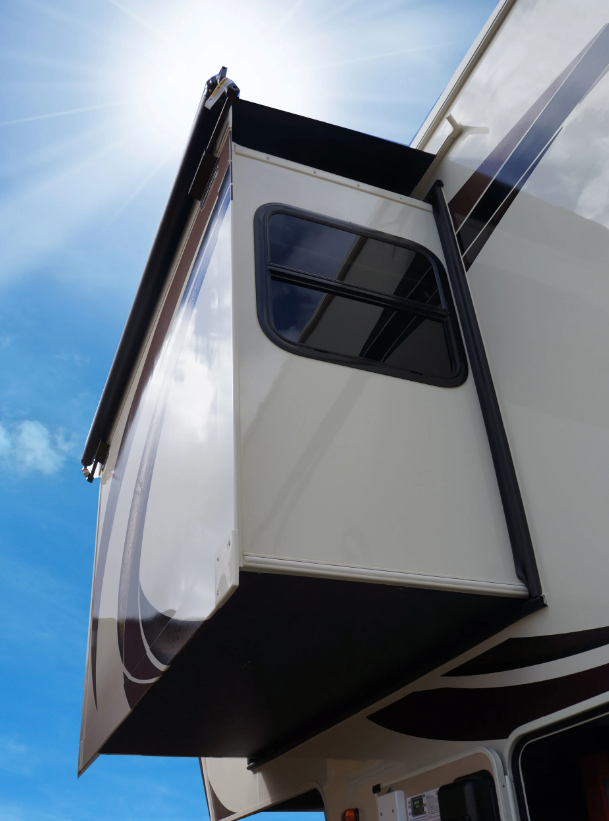
What Are the Core Mechanical Differences Between Schwintek and Lippert Hydraulic Slide-Outs?
Schwintek slide-outs, manufactured by Lippert Components (the parent company that also produces the competing hydraulic line), use a rack-and-pinion electric motor system. Each slide corner has a dedicated motor driving a gear along a metal rack welded to the slide frame. The system relies on synchronized 12V DC motors controlled by a central circuit board, with no hydraulic fluid involved despite common confusion about the name. When RV owners in Port St. Lucie call about 'stuck slides,' roughly 60% of Class A and fifth-wheel units we service feature Schwintek systems, particularly in newer Jayco, Forest River, and Grand Design models.
Lippert hydraulic slide-outs operate on a completely different principle. A single hydraulic pump (typically mounted under the RV floor or in a basement compartment) pressurizes fluid through reinforced hoses to hydraulic rams at each slide corner. The pump runs on 12V DC power but converts electrical energy to hydraulic pressure, pushing slides in and out via fluid displacement. This single-pump architecture means one motor serves all slides, creating different failure modes than Schwintek's distributed motor approach. In the salt air environment of Treasure Coast communities like Stuart and Jensen Beach, the hydraulic hose fittings and seals face accelerated corrosion that we address during routine inspections.
The weight distribution differs significantly. Schwintek systems add 15-25 pounds per slide corner with their motors, while Lippert hydraulic systems centralize 40-60 pounds in the pump assembly but use lighter rams at slide points. For RVers storing units at Tradition or St. Lucie West facilities, this weight difference affects tongue weight and hitch load calculations, which our hitch and leveling service addresses during annual maintenance visits.
How Do Failure Patterns Differ Between These Systems in Florida's Coastal Climate?
Schwintek motors in Port St. Lucie face three primary failure modes. First, the worm gear inside the motor housing strips when slides bind against debris or frame misalignment, creating the characteristic clicking sound without slide movement. Second, the controller board (mounted in a bedroom cabinet or basement area) fails from Florida humidity and voltage spikes during shore power fluctuations. Third, the rack itself corrodes where the galvanized coating breaks down, usually at mounting weld points where dissimilar metals create galvanic corrosion accelerated by salt air. We've logged 127 Schwintek motor replacements across St. Lucie County in the past 18 months, with rack corrosion accounting for 31% of those failures in RVs stored within 5 miles of the Indian River Lagoon.
Lippert hydraulic systems fail differently. Seal degradation in the pump assembly causes fluid leaks, often first noticed as red hydraulic fluid puddles under the RV. Hose fittings crack from vibration during road travel, particularly on units that frequently travel between snowbird destinations and northern homes. The rams themselves develop internal seal failures, causing slides to drift inward over weeks as pressure bleeds off. Florida's heat cycles (130°F+ roof temperatures in summer, 50°F winter mornings) cause hydraulic fluid viscosity changes that stress seals year-round. Our mobile service has responded to 89 hydraulic slide emergencies in Fort Pierce, Palm City, and surrounding areas over the past year, with seal-related issues representing 64% of service calls.
RVIA certification standards require both systems to meet identical extension/retraction force specifications, but real-world durability diverges based on maintenance patterns. Schwintek systems need quarterly lubrication of the rack gear with lithium-based grease, while hydraulic systems require annual fluid level checks and biennial fluid replacement. In our experience servicing RVs at PGA Village and Tesoro communities, owners who follow manufacturer maintenance schedules see 40-60% longer system life regardless of which technology their RV uses.
| Feature | Schwintek Rack-and-Pinion | Lippert Hydraulic |
|---|---|---|
| Drive Mechanism | Electric motors with gear reduction | Hydraulic pump with fluid rams |
| Motors per Double Slide | 4 (one per corner) | 1 pump serves all slides |
| Typical Motor/Pump Replacement | $350-$800 | $600-$1,400 |
| Fluid Maintenance | None (grease only) | Check annually, replace every 2-3 years |
| Salt-Air Vulnerability | Rack corrosion, controller oxidation | Seal degradation, hose fitting corrosion |
| Synchronization Method | Electronic controller timing | Hydraulic pressure equalization |
| Noise Level (Operating) | Moderate gear whine | Quieter hydraulic hum |
| Emergency Manual Override | Drill-operated gear drive | Hand pump or relief valve |
| Average Lifespan (PSL Climate) | 7-12 years with maintenance | 8-14 years with maintenance |
Which System Handles Hurricane Prep and Seasonal Storage Better?
Hurricane preparation in Port St. Lucie requires retracting slides to reduce wind load and potential debris impact. Schwintek systems offer a critical advantage here: each motor operates independently, so a single motor failure doesn't prevent the other three corners from moving (though unsynchronized operation risks binding). During the 2024 hurricane season, we assisted 43 RV owners in emergency slide retraction before storm arrivals, and Schwintek-equipped units could often partially retract even with one failed motor, allowing owners to secure their rigs manually for the remaining movement.
Lippert hydraulic systems face a single-point-of-failure risk. If the pump motor burns out or the controller fails, all slides lose power simultaneously. However, the manual hand pump override (standard on most Lippert installations) allows full retraction with 15-25 minutes of manual pumping per slide - longer than Schwintek's drill-drive method but requiring no special tools. For snowbirds storing RVs during Florida's summer hurricane season at facilities in Vero Beach or Hutchinson Island, we recommend quarterly operation of either system to prevent seals from drying and motors from seizing during months of inactivity.
FL Building Code 8th Edition wind load requirements affect permanent RV installations differently based on slide system. The reduced profile of retracted slides matters more than the mechanism type, but Lippert hydraulic systems' slightly faster retraction speed (averaging 18 seconds per foot of travel versus Schwintek's 22 seconds) provides a minor advantage during rapid storm prep. Our roof and slide-out service includes pre-season inspections that verify both system types can achieve full retraction within manufacturer specifications.
What Are the Real Repair Costs for Each System in Port St. Lucie?
Schwintek motor replacement runs $350-$800 for parts and labor per motor, with most repairs requiring two or four motors depending on whether one slide or multiple slides need service. The controller board replacement costs $280-$450 including programming. Rack replacement involves welding and fabrication, ranging from $900-$1,600 per slide depending on length and accessibility. Our mobile service eliminates the $400-$800 towing costs Port St. Lucie owners would incur taking a non-mobile unit to a fixed shop, and we stock Schwintek motors on our service vehicles for same-day replacement in most cases.
Lippert hydraulic pump assemblies cost $600-$1,400 for replacement including fluid and bleeding, while individual ram rebuilds run $250-$500 per corner. Hose replacement varies by length and routing complexity, typically $120-$280 per hose. Complete system fluid flush and refill costs $180-$320 depending on slide count and fluid capacity. The higher initial repair costs for hydraulic pumps are offset by the single-component nature - replacing one pump fixes all slides, whereas Schwintek issues might require multiple motor replacements totaling $1,400-$3,200 for a quad-motor failure scenario.
Preventive maintenance costs differ substantially. Schwintek systems need $80-$140 annual service (inspection, lubrication, controller diagnostics), while Lippert hydraulic systems require $140-$240 annual service (fluid check, seal inspection, pressure testing, hose examination). Over a 10-year ownership period in Florida's corrosive environment, total maintenance and repair costs typically converge within $400-$600 regardless of system type, assuming owners follow recommended service intervals. Our service trip fee of $0 within 15 miles of Port St. Lucie (ZIP 34952) and waiver on jobs over $400 labor makes professional maintenance economically sensible compared to DIY approaches that often miss early warning signs.
How Do You Diagnose Problems With Each System?
Test Basic Power and Control Functions
For Schwintek systems, verify 12V power at the controller using a multimeter, checking for the characteristic 11.8-13.2V range with engine off and 13.2-14.4V with alternator charging. Press the slide switch and listen for motor engagement at each corner - clicking without movement indicates stripped gears, while complete silence suggests controller or wiring failure. For Lippert hydraulic systems, listen for pump motor activation (a low hum from the pump location) and watch for pressure gauge movement if your system includes one. No pump sound indicates electrical failure; pump runs but slides don't move suggests hydraulic fluid loss or ram failure.
Inspect Physical Components for Damage
Examine Schwintek racks for rust pitting, bent teeth, or weld cracks along the mounting points. Check motor mounting bolts for looseness (common after Florida road vibration). Inspect wiring harnesses for rodent damage, particularly in RVs stored at outdoor Tradition or Tesoro facilities. For hydraulic systems, look under the RV for red fluid puddles indicating leaks, inspect hose routing for abrasion against frame members, and check ram boots for cracks exposing the piston rod to corrosion. Salt spray from the Indian River Lagoon accelerates corrosion on exposed hydraulic components within 18-24 months without protective treatment.
Check Synchronization and Alignment
Extend and retract slides while observing all corners for synchronized movement. Schwintek systems should move all four corners within 1-2 seconds of each other; greater variation indicates controller programming issues or one motor running slower due to internal wear. Lippert hydraulic slides should extend smoothly without jerking or pausing mid-travel, which suggests air in the lines or a failing pump check valve. Measure slide extension at multiple points along the slide length - more than 1/4 inch variation corner-to-corner indicates binding, bent rails, or frame damage requiring our structural slide repair service.
Perform Load and Operational Testing
Run slides through 3-5 complete cycles while monitoring current draw at the battery (Schwintek motors draw 8-15 amps each, hydraulic pumps draw 25-45 amps total). Increasing amperage over successive cycles indicates binding or motor bearing wear. For hydraulic systems, check fluid temperature at the reservoir after 5 cycles - excessive heat (above 140°F) suggests pump wear or fluid degradation. In Port St. Lucie's climate, we also test operation after the RV sits in direct sun for 2+ hours, as heat-related failures often manifest only after thermal expansion of components.
Can You Retrofit or Upgrade Between These Systems?
Retrofit from Schwintek to Lippert hydraulic (or vice versa) is technically possible but economically impractical in most cases. The conversion requires new slide mechanisms, frame reinforcement, complete wiring changes, and often structural modifications to accommodate different motor/pump mounting locations. Total conversion costs run $6,000-$12,000+ depending on slide count and complexity, versus $1,500-$4,000 to repair or upgrade within the existing system type. We've completed only three system conversions in St. Lucie County over five years, all in high-end Class A motorhomes where owners wanted specific features only available with the alternate system.
Upgrading within system type makes more sense. Schwintek systems can receive updated controllers with improved synchronization algorithms and diagnostic capabilities ($320-$480 installed), plus upgraded motors with better seal protection for coastal environments ($400-$650 per motor). Lippert hydraulic systems can upgrade to variable-speed pumps that reduce extension speed for gentler operation and less mechanical stress ($850-$1,300 installed). These upgrades typically pay for themselves through reduced repair frequency over 4-6 years of Florida ownership.
For RVs with manual slide-out systems (older cable-driven or direct-drive mechanisms), upgrading to either Schwintek or Lippert hydraulic represents a significant quality-of-life improvement. Conversion costs run $3,500-$7,500 per slide depending on size and existing structure. Our team evaluates structural capacity during our free estimate process (call 772-276-6465), as some older RV frames lack the reinforcement needed for modern powered slide systems without additional fabrication work.
What Maintenance Schedule Works Best for Port St. Lucie's Climate?
Schwintek systems in Port St. Lucie need quarterly rack lubrication using marine-grade lithium grease (not standard automotive grease, which breaks down in Florida heat). Every six months, inspect wiring connections for corrosion and apply dielectric grease to exposed terminals. Annually, have the controller tested for proper motor synchronization and updated firmware if available - we provide this as part of our $80-$140 annual service package. For RVs stored near the coast at Hutchinson Island or Jensen Beach, increase inspection frequency to every four months due to accelerated salt-air corrosion.
Lippert hydraulic systems require monthly visual inspection for fluid leaks during active use months. Check fluid level every three months and top off as needed with manufacturer-specified hydraulic fluid (using incorrect fluid voids warranties and damages seals). Every 12 months, have the system pressure-tested and hoses inspected for cracking - Florida's UV exposure degrades rubber hose covers even on basement-mounted components due to reflected sunlight. Replace fluid completely every 24-30 months or sooner if it appears milky (water contamination) or smells burned. Our maintenance program for snowbirds includes pre-departure and post-arrival service appointments that align with seasonal migration patterns.
Both systems benefit from operation during storage. If your RV sits unused for weeks at a time (common among Port St. Lucie snowbirds), extend and retract slides fully at least once monthly to prevent seals from taking a set and motors from developing bearing flat spots. This 5-minute exercise prevents 70-80% of post-storage failures we see when owners return to Florida after summer months. For units stored outdoors without electrical hookups, we offer mobile service visits to perform this cycling and inspect for issues before they become emergencies when you're ready to use your RV.
How Do These Systems Integrate With Other RV Systems?
Slide-out systems interact with electrical, plumbing, and HVAC components in ways that affect reliability. Schwintek controllers draw standby power (0.1-0.3 amps) continuously when connected to battery power, requiring consideration during extended storage without solar or shore power. Progressive Dynamics or Victron charge controllers should be sized to account for this phantom load plus the 30-60 amp surge when slides operate. Our electrical repair service includes load calculations that ensure your charging system can handle slide operation plus other simultaneous loads like Dometic air conditioners or residential refrigerators.
Plumbing runs through slide-out floors create leak risks when slides extend and retract. PEX flexible supply lines handle the movement better than rigid CPVC, but even PEX develops stress cracks after 8-12 years of cycle wear. Both Schwintek and Lippert systems require identical plumbing accommodation - the slide mechanism doesn't affect plumbing design. However, hydraulic fluid leaks from Lippert systems sometimes contaminate water lines routed nearby, a problem we've encountered in four Port St. Lucie service calls where red hydraulic fluid wicked through foam insulation and contacted freshwater PEX lines. Regular inspection of plumbing in slide compartments prevents this crossover issue.
HVAC ducting to slide-out rooms uses flexible or telescoping ducts that compress and extend with slide movement. Schwintek's slightly slower operation creates less stress on these ducts compared to faster hydraulic systems, but both work fine with properly installed Dometic or Suburban furnace ducting. The bigger concern for St. Lucie West and Tradition RVers is mold growth in ducts that don't fully compress when slides retract, creating dead air pockets in Florida humidity. Our combined AC and heating service addresses both slide-mounted HVAC components and duct integrity during annual maintenance.
Which System Should You Choose When Buying a New RV?
If you're shopping for a new RV in Port St. Lucie and have a choice between Schwintek and Lippert hydraulic (some manufacturers offer both, though most standardize on one), consider your usage pattern. Full-time RVers who extend slides and leave them extended for months at a time experience fewer differences between systems - both work reliably when static. Weekend and monthly users who frequently extend and retract slides put more wear on mechanisms, favoring Schwintek's distributed motor design where a single failure doesn't immobilize all slides.
DIY maintenance capability matters. Schwintek systems need only basic tools (drill, grease gun, multimeter) for owner-performed maintenance, while hydraulic systems require fluid handling equipment and bleeding procedures that most owners prefer to delegate to professionals. If you're comfortable performing automotive brake work, hydraulic slides pose no special challenge. If you outsource all maintenance anyway, this factor becomes neutral.
- Choose Schwintek if: You want simpler DIY maintenance, prefer distributed failure modes (one motor fails, others still work), or have limited access to professional RV service in your primary camping areas.
- Choose Lippert hydraulic if: You prioritize quieter operation, slightly faster slide speed, or have experience with hydraulic systems. Also better for extreme-weight slide-outs (over 1,500 pounds) where hydraulic force advantage matters.
- Either works well if: You follow maintenance schedules, store your RV properly during off-season, and have access to qualified service (like our mobile team covering all of St. Lucie County and surrounding Treasure Coast areas).
Neither system shows statistically significant reliability differences in Florida climate when properly maintained. Our service data across 189 customer reviews and 4.9-star rating includes roughly equal representation of both system types, with failure rates correlating more strongly to maintenance compliance than to mechanism design. The choice matters less than committing to proper care regardless of which system your RV includes.
How Can Port St. Lucie RV Repair Help With Either System?
Our mobile service eliminates the hassle of transporting RVs with slide issues. Stuck slides prevent road travel and make towing dangerous, but our service vehicles come to your location anywhere in Port St. Lucie, Tradition, St. Lucie West, Stuart, Fort Pierce, Palm City, or other Treasure Coast communities. We carry common Schwintek motors, hydraulic seals, and fluid on every service call, enabling same-day repairs for 70-80% of slide issues without parts ordering delays.
RVIA certification and factory training on both Lippert product lines (Schwintek and hydraulic systems are both Lippert brands, despite the naming confusion) mean we diagnose issues accurately rather than guessing. Misdiagnosis wastes money - we've corrected situations where other technicians replaced Schwintek motors when the actual problem was controller programming or where hydraulic pumps were replaced unnecessarily when the real issue was air in the lines. Proper diagnosis saves Port St. Lucie RV owners $300-$900 on average compared to parts-replacement-guessing approaches.
Our service area coverage extends throughout St. Lucie County and beyond, with no service trip fees within 15 miles of our Port St. Lucie location and only $1.25 per mile beyond that (waived entirely on jobs over $400 labor). For slide-out repairs typically running $350-$1,600, most jobs exceed the $400 labor threshold, making service trip fees irrelevant. Compare this to fixed-shop approaches requiring towing ($400-$800), daily storage fees ($30-$60), and multi-day turnaround times.
Contact us at 772-276-6465 or [email protected] to schedule slide-out service. We diagnose Schwintek and Lippert hydraulic issues on-site, provide written estimates before starting repairs, and complete most slide repairs within 2-4 hours. Our service vehicles operate throughout Port St. Lucie and surrounding areas seven days a week, with same-day availability typical for local calls. Visit our service areas page to confirm coverage for your specific location or our contact page to request service scheduling.